Comparison
40 kHz vs. 120 kHz Ultrasonic Cleaning
Two frequencies. A comparison that starts with the method.
The question
40 kHz or 120 kHz? Which one is the better frequency when it comes to cleaning your records? You might automatically think 120 kHz as it’s the larger number of the two, but bigger doesn’t mean better. It also doesn’t mean worse. What that number gets at is the kind of cleaning it does. To wrap our heads around that we have to first tackle what ultrasonic cleaning is and how it works.
The Method: Cleaning With Sound
Our hearing, meaning us humans, can hear sounds that top out around 20 kHz. Anything above that lands into “ultrasonic” territory. When we throw out numbers like 40 kHz and 120 kHz, we are talking about sounds we can’t hear.
When it comes to an ultrasonic tank, it’s basically a reservoir filled with water, and it has transducers mounted to it. These transducers vibrate when electricity passes through them, reaching a particular frequency, and those vibrations send pressure waves through the tank. As they do, the water is both squeezed and stretched. When it’s pulled apart, tiny cavities form and grow. As it’s then squeezed near a surface, it implodes. This all happens at a microscopic level. That implosion ejects a jet of liquid. That, and the associated shock wave, scrubs the surface. This process is called cavitation, and it’s a touch-free method of cleaning a record where millions of microscopic explosions happen all over the record’s outer surface and within the groove.
So what’s the frequency?
The difference between 40 kHz and 120 kHz has everything to do with how many times a second the water gets stretched and squeezed. At 40 kHz it’s 40,000 times, and at 120 kHz it’s 120,000. That’s a lot of activity.
Because frequency controls the length of the stretch, it also controls the size of the bubbles. The longer the stretch, the larger the bubbles grow because they have more time to do so. So 40 kHz’s 40,000 stretch-and-squeeze cycles make larger bubbles than 120 kHz’s 120,000 cycles. The larger the bubble, the more powerful the implosions. The shorter the stretch, the smaller the bubble. With 120,000 of these cycles, there are a lot more bubbles, but they have weaker implosions.
A good rule of thumb here is that lower frequencies produce larger, more energetic bubbles, and higher frequencies create smaller, more numerous ones.
You’ll hear folks say that the larger bubbles won’t get into the groove of the record because they won’t fit, but the smaller bubbles, those formed at 120 kHz, do. There is some truth to that, but what the argument leaves out is the implosions. A bubble doesn’t have to enter a groove to clean. The implosion, aided by a surfactant, allows the fluid to wet the groove. The bubble’s diameter doesn’t tell us if the frequency can clean it.
40 kHz: The blunt instrument
40 kHz is the most common one used in ultrasonic cleaners. It has muscle. That muscle is used to clean jewelry, lab equipment, and records. A record that carries decades of hardened grime stuck to it benefits from the punch a large 40 kHz-formed bubble gives.
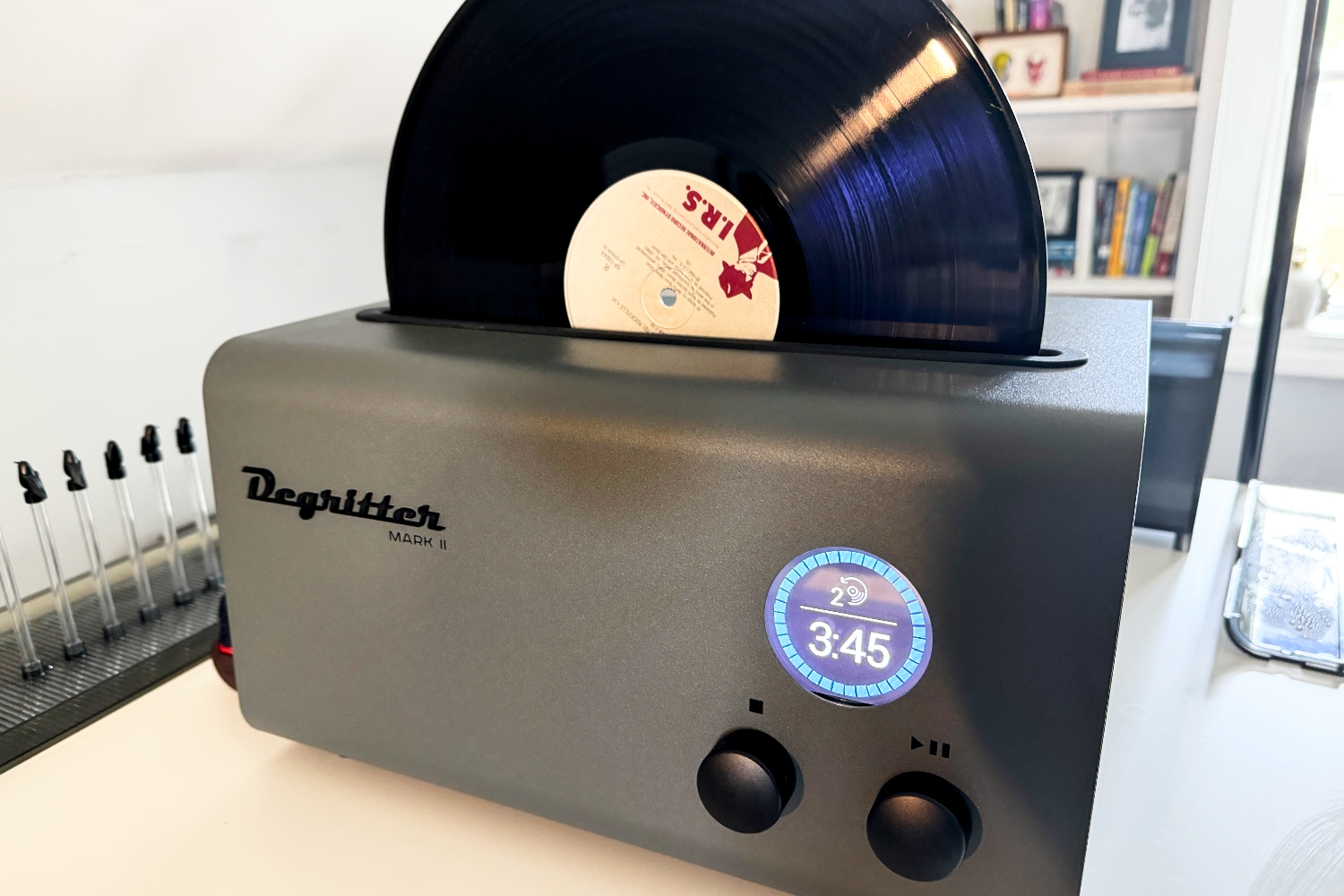
Does that “punch” hurt the record? I wouldn’t worry about it. There is no evidence to support that. What does damage records is heat, and cavitation creates heat. Many of the producers of higher-end ultrasonics (like the Degritter, which operates at 120 kHz) are aware of this and take precautions to keep the temperature below 35 degrees Celsius (or 95 degrees Fahrenheit).
120 kHz: The precision tool
The smaller, 120 kHz-produced bubbles are a more delicate touch. They are abundant and they are densely packed. There are a lot of them. Because they are smaller than the groove, they do a lot of their action against its walls, dislodging tiny bits of paper, dirt, or anything else they can point their implosions at.
Because they lack the muscle of the 40 kHz-formed bubbles, they sometimes benefit from a pre-clean to remove some of the more stubborn contaminants. What they have going for them is numbers and distribution. The more tiny workers chipping away at the stubborn dirt clinging to the groove walls, the better.
Where the record comes in
The right question to ask isn’t about which frequency is better. The more appropriate one is what state are the records in? Are they newer records or used records that come from a source you trust and appear visually clean? The finer and gentler action of 120 kHz makes a lot of sense. If you are typically crate digging and bringing home dirtier records, a pre-clean is probably necessary, and 40 kHz may have the punch you need to dislodge stubborn particles.