My Cleaning Bench
Cleaning Fluid
The cleaning fluid on my bench.
What I use
I have spent too much time learning about the various chemicals used to clean records and why they are used. It’s a rabbit hole that never really ends. It’s safe to say I’ve tried everything over the last few decades. By everything, I mean things like the Discwasher fluid back in the 80s, Tergikleen in the 2000s, and various DIY formulas that included everything from drops of Dawn dish soap, vinegar, and isopropyl alcohol. I will say that none of those past attempts to find the “perfect” formula harmed a record, but I was never satisfied. There was always more surface noise than I thought there should be. Those pops and clicks that people complain about? It’s not always groove damage or inherent in the record itself (unless it’s a very poor pressing). Other times it’s contamination or residue from a cleaning formula that was insufficient for the job. More scrubbing isn’t necessarily going to remove decades-old Discwasher residue at the bottom of a groove.
The chemicals I use today have proven effective at removing past cleaning mishaps and reducing surface noise to a point where, on many records, it’s practically absent.
I want to give props to Neil Antin and his guide Precision Aqueous Cleaning of Vinyl Records, which served as inspiration for much of what I do today. What I eventually realized is that my mistake was looking for the one perfect formula. Different contaminants require different solutions.
Let’s get into the chemicals you’ll find on my bench today.
Alconox Liquinox
This is used in my first cleaning step. It’s a high-foaming detergent that is primarily anionic, meaning its surfactant molecules carry a negative charge. It is non-flammable and biodegradable.
Liquinox is the perfect degreaser. It’s my detergent pre-cleaner to remove fingerprints, organic oils, skin cells, and other compounds. If it’s greasy or biological, Liquinox is up for the job. It has excellent wetting capability and allows the liquid to penetrate the groove instead of beading up on the record’s surface.
Mix: 10 mL per liter of distilled water.
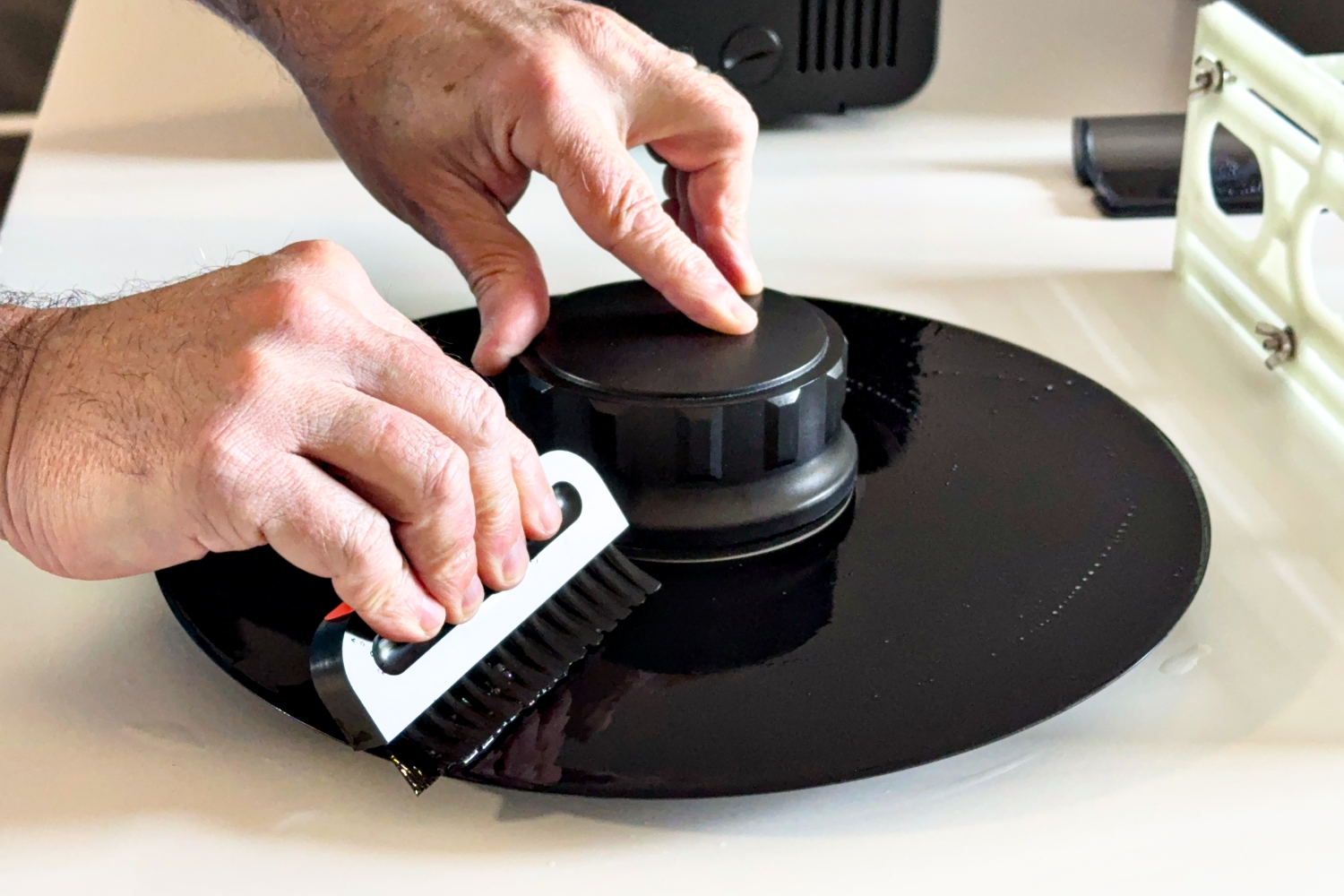
Application: Manual with brush.
Removal: Record Doctor vacuum machine to pull the organic gunk away before the next step.
Alconox Citranox
My second step cleaner, also anionic. This is an acid cleaner used to dissolve mineral-based contaminants. This includes things like hard water salts, calcium deposits, and aerosols that detergent can’t remove. It’s a safe acid blend that uses citric and glycolic acids. It is also biodegradable and non-flammable.
With the organic layer of contaminants removed by Liquinox, Citranox now has direct access to the inorganic stuff.
Mix: 15 mL per liter of distilled water.
Application: Manual with brush.
Removal: Record Doctor vacuum machine to pull the inorganic contamination away before the next step.
Dow Tergitol 15-S-9
My final cleaner. It’s non-flammable, biodegradable, and non-ionic (less foam).
Tergitol 15-S-9 is great at removing any remaining film left by the two pre-cleaners. Think of it as the final scrub.
Mix: 0.01% or about 0.1 mL per liter of distilled water.
Application: Ultrasonic.
Removal: Record Doctor vacuum machine before the distilled water rinse.