My Cleaning Bench
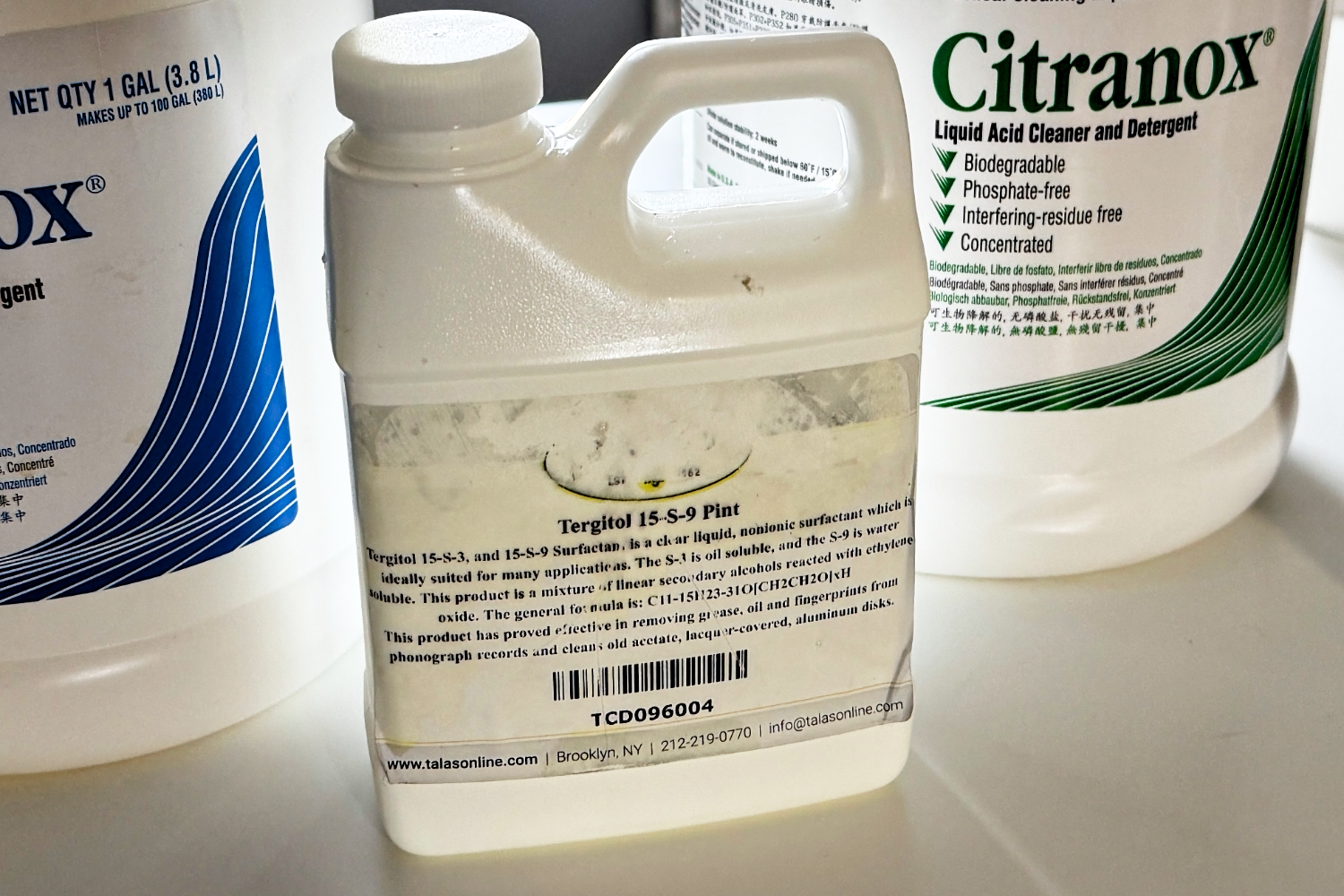
Surfactant
Why a surfactant matters.
Water is bad at getting things wet.
Seriously. It is. Drop some water on a record and watch to see what it does. It forms a little bead or series of beads, doesn’t it? That’s because of surface tension.
Water molecules are extremely attracted to each other. They’ll stick together instead of separating and spreading across a surface. That poses a problem when we are trying to clean a record.
Let’s look at why that is. A groove is extremely small. Microns in width. As tiny as it is, things get in there. There are oils, residues from past cleanings or handling, and other contaminants. To clean it, the cleaning fluid has to get to it. Trying to do so with water alone is a lesson in futility. The water needs help. Without it, the water tends to resist spreading and stubbornly bridges the top of the groove.
Enter a surfactant, and it has two jobs.
The first is to loosen water’s grip on itself. Surface tension drops, and the water becomes much more willing to flow into the groove. It’s inherent in the name, a surfactant is a “surface active agent,” and chemists call what it does “wetting.” Remember I said that water is bad at getting things wet? Coupled with a surfactant, it excels at it.
Its second job has everything to do with the junk and gunk buried in the groove. These are skin oils, chemicals from the pressing plant, old cleaning agents, and the smoke from someone’s joint back in the 1970s when the record was first played.
Fingerprints are a great example. Those swirls left behind are formed by layers of sweat and body oils. They’re not even hidden. They are right there on the surface of the record. If you pour water over it, what happens?
Nothing.
That’s because oil and water don’t mix. Water will just slide right over and past it.
Add a small amount of surfactant, and things get interesting. Not only does it insert itself between the water molecules, but it also serves as a little chemical magnet with a split personality. One personality, the hydrophilic head, loves water, and the other, the hydrophobic tail, loves fats, oils, and grease.
Toss that surfactant molecule in with a bunch of water molecules, and the hydrophobic tail immediately looks for a way out. Something else happens, and it’s where things get very interesting. When the concentration of surfactant to water hits a certain level, called the critical micelle concentration (or CMC), the molecules begin grouping together, sometimes into a sphere. That sphere is simply known as a micelle. The outer part is made up of the hydrophilic heads because they love the water, and the tails are pointed inward, away from the water.
Now pour the surfactant/water mix over something oily, like that fingerprint and the stuff inside the groove. The oil- and grease-loving tail dives right into it and latches on. The water-loving head stays attached to the water. If you agitate that mix, the tail pulls whatever it latched onto away and into the center of the micelle sphere. Now you can think of the micelle as a microscopic globe of grease surrounded by water molecules that carry it away.
The dirt that’s been removed hasn’t vanished. It’s still there, suspended in the sphere. Time to get it off the record. Rinse it off or place the record on a vacuum machine and the job is done.