Cleaning Fluids
Understanding Cleaning Fluids
Detergents, surfactants and rinsing: the topics behind the bottle.
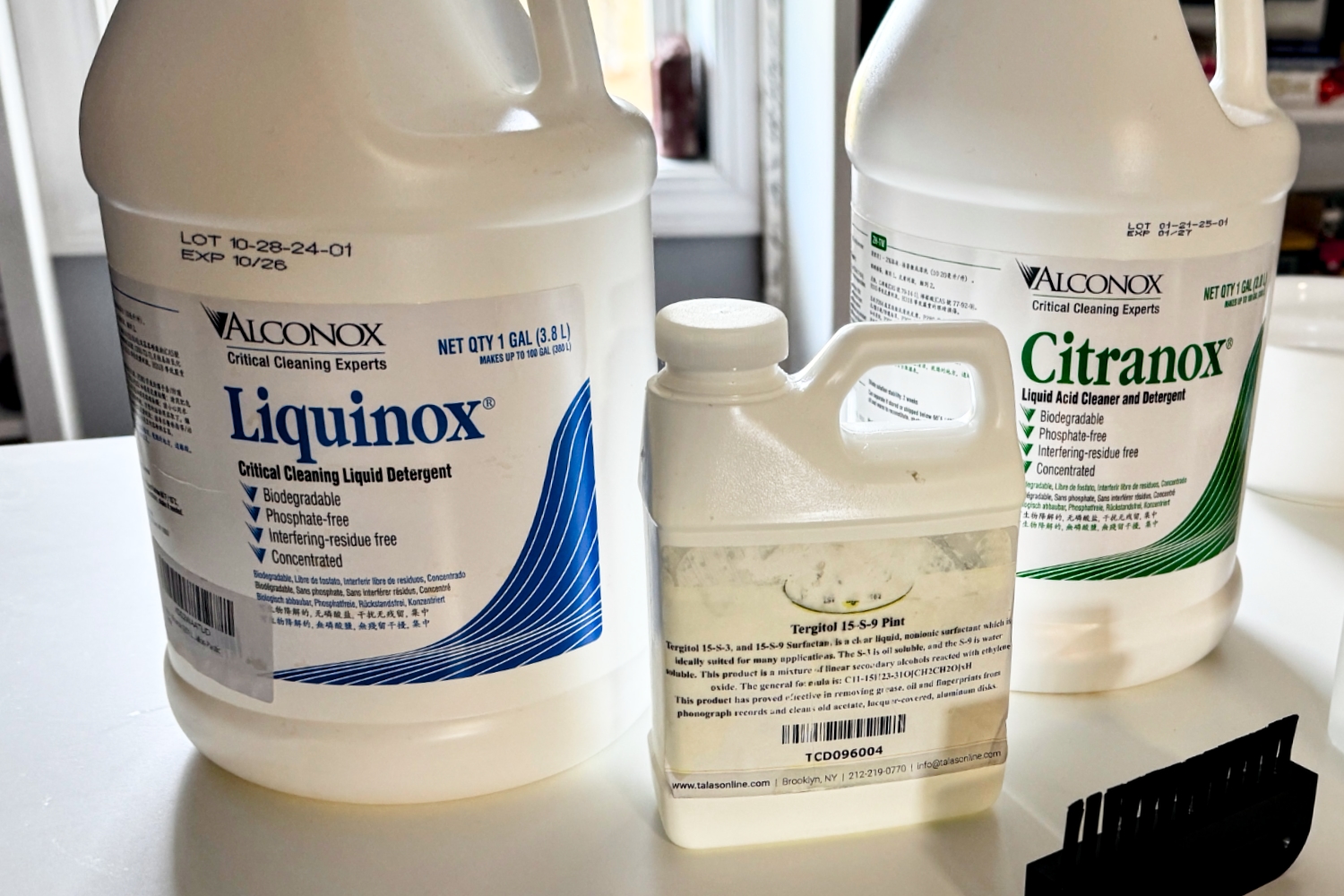
What’s in the bottle?
Read about record cleaning formulas online and you’ll see terms like detergent, surfactant, and nonionic that make it seem like you need a chemistry degree. I certainly don’t have one, and the last few years have been a learning experience on what works best and why. Consider this a crash course on what some of these terms mean, why we care, and why rinsing may be the most important takeaway.
Surfactants - the Magic Ingredient:
I’ve written about surfactants here, and I’m a big believer that the more times you are exposed to something the more likely it is to stick, so here goes.
A surfactant is a molecule and the term is short for “surface active agent”. It also has two personalities that are represented by the two ends of the molecule. One loves water. The other one not only despises water, but it’s attracted to oils and grease. This makes it the perfect candidate to assist us in cleaning not only a record’s surface but also its groove.
Along with two personalities, a surfactant does two jobs. One is to break the water’s surface tension. That’s what causes the water to bead up on a surface. The surfactant molecule reduces the surface tension, allowing the water to flow over the record and into the groove. The second thing they do is to carry any grease and oils away, thanks to the end that loves to grab hold of any oils and organic materials it encounters.
Another thing chemists will throw around when talking about surfactants is their electrical charge. Specifically when it comes to the water-loving end of the molecule.
Anionic surfactants have a negative charge. They are great at lifting grease away, but some are exceptionally foamy. We care about this when it comes to rinsing records after cleaning. We also care when it comes to our equipment. Foam doesn’t necessarily play well with ultrasonic machines or vacuum machines.
Cationic surfactants have a positive charge. Because of this, they like to stick to things that are negatively charged. Hair conditioner is a good example of this. The surfactant molecules in your favorite bottle of conditioner are what cause it to stay put when you rinse. If we’re talking about a record, the last thing you want is a surfactant that refuses to let go.
Nonionic surfactants are neutral. They carry no charge at all. Many are low-foaming, excellent wetting agents, and they rinse away easily. That’s what makes them the perfect choice for our record cleaning recipes and machines.
Detergents
Some folks use the terms “detergent” and “surfactant” as if they are interchangeable. They aren’t. They are related. A detergent contains surfactants, but it also contains other things to help tackle whatever problem it was formulated to tackle. Some of those other things are chelating agents that go after mineral particles, pH adjusters that change the acidity depending on what is being targeted, and enzymes that break down certain organic materials.
There are things in some detergents that we definitely want to leave out of the record cleaning equation; think fragrances, dyes, and moisturizers. None of which deserve any place in a record cleaning routine or formula.
One thing that needs to be mentioned. Foam does not equal cleaning power. A formula with heavy foam is a problem with many machines, and detergent can dry and clog hoses, drain plugs, and filters.
Rinsing: The Step to End all Steps
Let’s say you’ve created an amazing cleaning formula that does exactly as you’d planned. All of the oils and hard minerals have been loosened from the groove and the surface. They are floating in the cleaning fluid instead of being stuck to the vinyl surface. Now you need to get that fluid off the record.
Some routines would have you air dry. Maybe even after wiping the surface clean with a dry cloth. But what happens with the trace amount of fluid and its flotilla of contaminants, after the fluid evaporates? The contaminants settle back onto the record and into a new spot. All that’s been accomplished is a relocation.
Imagine if you went to a restaurant and your food was served on dishes that had been cleaned but not rinsed.
Records need to be rinsed after cleaning as well. There is a difference, though, between rinsing a record and rinsing a dish. You can rinse a dish with tap water, but a record should be rinsed with distilled or deionized water. Tap water contains dissolved minerals. When it dries, they are left behind. It’s why hard water can leave you seeing spots.
And here’s a little tip. Rinse once and there may be a very small amount of the mixture still clinging to the record. Let’s say a tenth of it. A second rinse that removes the same proportion leaves a tenth of a tenth. That’s one hundredth. It’s all about dilution.
Rinsing matters.